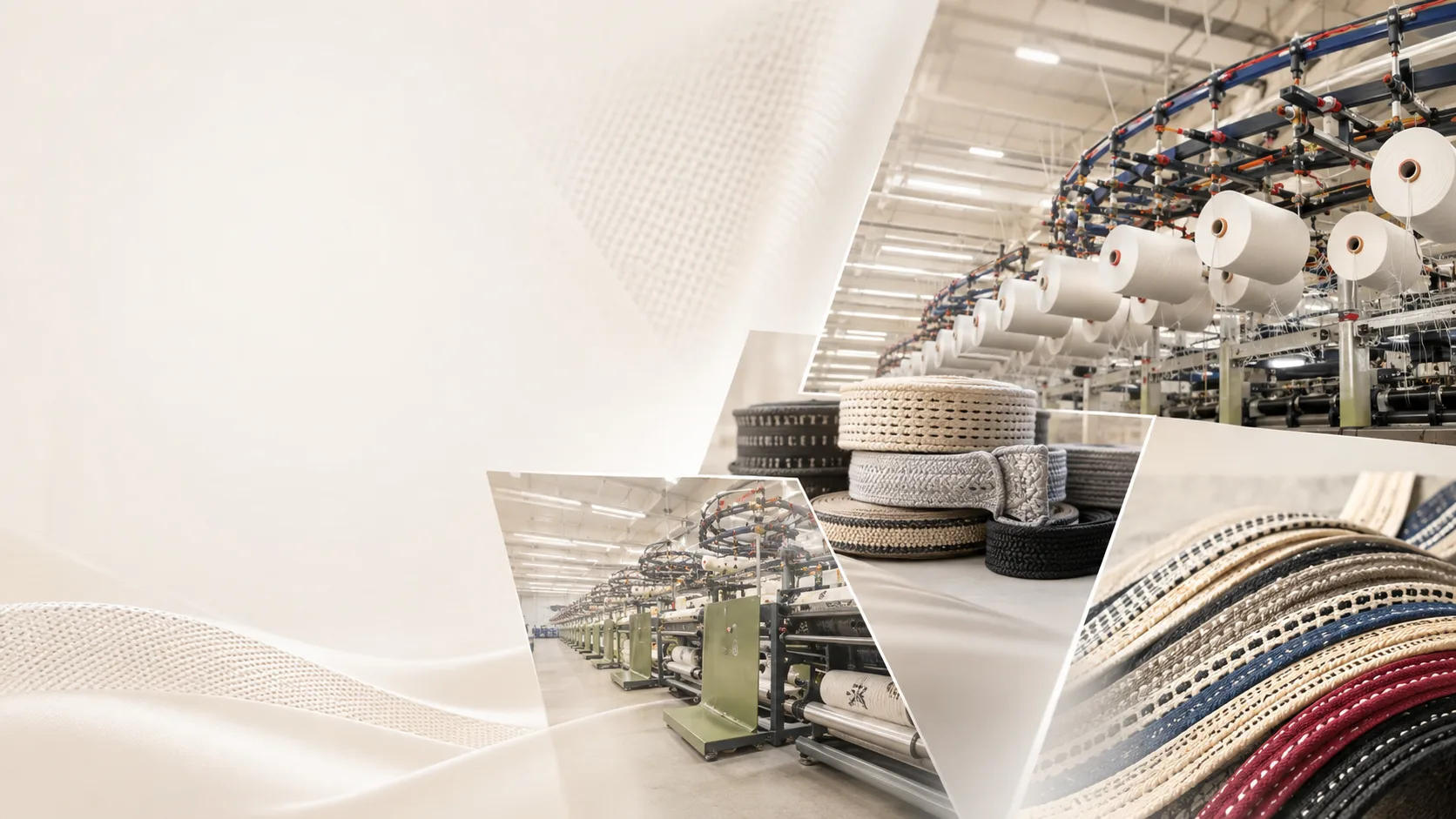
Technical-textile narrow weaving should be specified around function, repeated loading and assembly conditions rather than appearance alone. The required performance can change significantly between applications.
Custom color & sizeDirect manufacturer contactFast quotation process
Narrow Weaving
Narrow WeavingUpdated: Aug 29, 2026Bilge Örme Technical Content Team
30-SECOND SUMMARY
Quick answer: narrow weaving for technical textiles
Technical selection begins with load, movement and attachment conditions.
Repeated performance is often more important than maximum one-time stretch.
Hardware, stitching and environmental exposure should be tested as a complete system.
Technical-textile narrow weaving should be specified around function, repeated loading and assembly conditions rather than appearance alone. The required performance can change significantly between applications. This guide is designed to help purchasing, product-development and production teams separate the key technical criteria and move directly to the relevant Bilge Örme product pages.
Define the functional requirement
Identify whether the tape must stretch, restrain, stabilize, distribute load or simply guide a component. The same nominal width can serve very different purposes depending on the weave, elastic core and attachment method.
Consider repeated loading and recovery
Technical products may be cycled thousands of times. A construction that performs well in a single manual pull may not maintain its recovery after repeated use, so the expected duty cycle should be included in the project brief.
Evaluate abrasion and contact surfaces
Passing through slots, buckles or rough surfaces can introduce abrasion and heat. Surface finish and yarn choice should be considered together with the hardware, not as isolated material specifications.
Account for environmental conditions
Temperature, moisture, washing, chemicals or outdoor exposure can influence a textile component. The relevant environment should be communicated before production so suitable yarn and construction options can be evaluated.
Validate the complete assembly
The most useful test is performed with the actual sewing method, hardware, load and operating range. This system-level approach helps identify failure modes that are not visible when testing a loose tape by itself.
TECHNICAL NOTE
A product name alone does not guarantee technical equivalence.
Size, surface, working stretch, recovery, sewing or connection method and the final operating conditions should be evaluated together. When replacing an existing component, a physical sample and real use case provide the strongest reference.
Questions about narrow weaving for technical textiles
Does technical narrow weaving always need high stiffness?+
No. Some applications need softness and controlled recovery, while others require dimensional stability.
Can the same webbing be used with different hardware?+
Not automatically. Slot geometry, friction and edge contact can change performance and should be validated.
What information should be shared with the manufacturer?+
Provide the function, load or movement, width, environment, attachment method, quantity and any existing sample or test requirement.
CONTENT OWNERBilge Örme Technical Content Team
Our content is prepared around Bilge Örme product families and production-focused field experience to support better product selection. Order-specific technical values should be confirmed against the sample and project conditions. Review our technical content policy and production and quality approach.
This content is for general technical guidance. Final product suitability, production construction and performance values may vary according to order conditions and sample approval.